
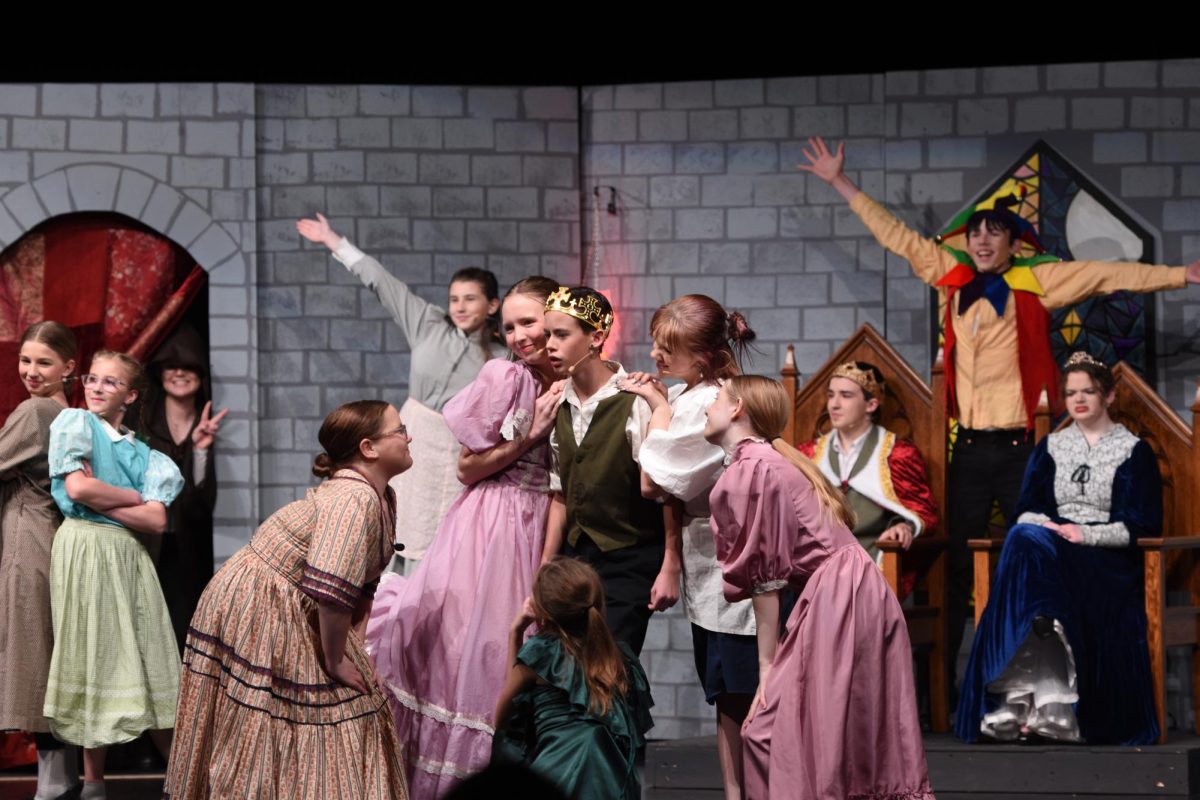
Some developments are characteristic of autumn: accumulations of dry leaves on browning grass, the rapid shortening of daylight hours, and the annual musical from the Cannon Falls theater department. Perhaps the best indicator that a school year has taken full force, the musical is a hallmark of fall extracurricular activities.
That’s not to say that it is unchanging. Over the last four years, musicals have come and gone with varying theatrics, cast demographics, themes, and more. It is not uncommon for a comparison between two consecutive performances to yield a considerable difference. Indeed, some shows break norms, with the program’s recent adaptation of The Princess and the Pea being one of them.
Compared to other shows, Princess and the Pea is comparatively short, with a length of less than forty-five minutes. That meant no intermission for the primarily young audience to stretch their legs, but also less time for them to sit still, which was a tradeoff that paid dividends as spectating children remained silent throughout. The compressed showtime also made for a fast-moving plot, keeping the performance engaging and efficient – again beneficial for the watching children. In short, while this year’s fall musical lagged in performance time compared to its predecessors, the difference accommodated the young audience well.
No musical would be complete without singing. The theater crew clearly demonstrated awareness of this fact with well-rehearsed – and executed – singing, especially for a cast with only one upperclassman. The lack of age, then, did not equate a lack of talent, with observer Dawson Sanford asserting he recognized the flair. “I thought the singing was good,” Sanford said.
Tucker Nobach, who played a lead role during the show, credited his vocal confidence to his years of musical experience. Furthermore, “one-on-one practice with my coaches, my directors, and friends cheering me on,” helped, Nobach said.
Where the vocal confidence of the cast was especially pronounced was during solo songs. With the shortened time parameters, there were less opportunities for singing in general, so the department made sure to maximize solo and duet performances: Prince Nicholas’s “Happily Ever After” and “Where is my Bride?”, Hannah’s “A Picture Perfect Bride,” and more. The ensemble was reserved strategically in order to give reprieve for solo singers, making for a well-rounded show.
Accompanying the smoothly performed music and compact showtime was an efficient and clever use of the set and characters. A notable way that the theater department minimized bloat in the musical’s runtime was to eliminate set changes. While perhaps seeming minor, an absence of major changes in background (castle walls, furniture, etc) played an important role in keeping the audience’s attention and streamlining the flow of the shortened musical by omitting the brief breaks in action typically present in performances to allow for set change. Adding to the benefit of the single set was a clever use of the cast. Since the pool of actors to draw from in this year’s musical was smaller and younger than previous shows, it had to be used wisely. It was. With few costume changes and an agile ensemble, the efficiency of the set was complemented by the careful use of the cast.
Thus, a trifecta was achieved in November 21’s fall musical: with compact length, vocal talent, and an efficient use of set and cast, the show catered well to both its young viewers and an older audience alike. Although the 2025 performance represented perhaps a greater deviation than usual from history, it still fulfilled its expected role as a harbinger of late autumn in a royal way.