
Many people make plans for their future. Whether it be what they’re going to have for lunch that day, what their plans are for the weekend, or much, much bigger. Something that many people don’t realize is that plans for college start to be made in eighth grade by many students.
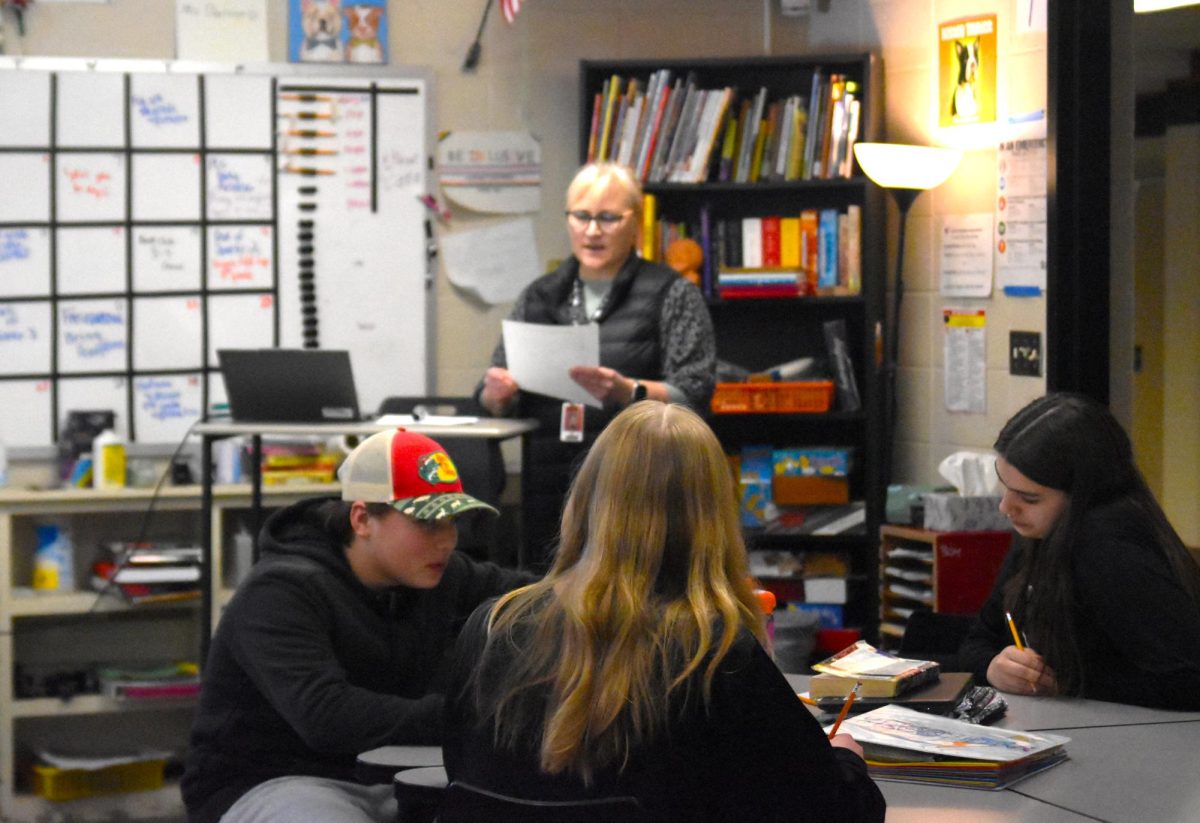
In the Cannon Falls School district, all eighth grade students take a Careers class, taught by Steve Clark. They cover many topics in that class, and around January, students start thinking about what classes they are interested in taking in high school. “We do this assignment in January, because that is around the time when registration for the next school year starts,” says eighth grade student, Lillian Olund. The goal of the Careers class is to improve employability skills and identify careers that suit each student’s specific strengths. “The recommended careers serve as a goal for students to use to guide for their individual strengths,” states Clark.
To graduate from Cannon Falls, twenty-four credits are required. Clark takes time to go through the registration handbook with his classes. This way, students know what is required for graduation, and all of the different course options there are available for them. “It was very helpful to go through the handbook, because I had no idea that there were so many options for classes to take!” Lillian exclaims. There are the standard classes, such as Geometry, US History, and Physics, but there are other classes such as Drafting and Woodworking. There are a wide variety of courses, because they are supposed to be tailored to what each student is interested in doing after they graduate.
Some eighth grade students find filling out the worksheet helpful, while others find it stressful. “I understand why we fill out the sheet, but I wish that it was more focused on ninth grade, instead of all of high school,” says Bella Boyum. “I don’t know what I want to do yet for a career, and it causes me some stress.”
One new component of high school is grades. Although grades are important during middle school, they become much more crucial during high school. Passing classes determines whether or not students earn enough credits, and without enough credits, graduation from high school is not possible.
Overall, it’s beneficial for students to take a Careers class. It prepares them for high school, college, and the workforce. What many people don’t realize is that for many students, preparation for college starts many years before college actually begins, and for good reasons; high school is a vital time of preparation for the future.

Cannon Falls seniors will soon be moving on to their next level in life, whether it be trade school, a family business, or the daunting college experience. While these seniors have already gone through the necessary process to advance in life, underclassmen will soon be looking toward the future. It is vital for these students to start thinking about college now, so they can be as well prepared for when the time comes to move on.
Applying for colleges is a huge step in moving forward through one’s educational career. However, it can be a daunting task for many high school students, and there will be inevitable mistakes and disappointment. Cannon Falls School District’s guidance counselor, Kirsten Hoffman, provided insight on the college application process. She emphasized the importance of research and visiting the campus prior to application. College Boards’ “Applying to College: FAQ” recommends to begin applying the summer before senior year, and taking junior year to “do a lot of prep work.”
Hoffman also explained how to fill out a college application. She recommended to “sit down and think of all the things you do, make a list, and then pick the most important 3-5 activities – explain what they are.” This may include volunteering, working for grandparents or family members, or extracurricular activities. Additionally, it is ideal to go the extra mile; “Anyone can go to Feed My Starving Children for a 2-hour shift, but did you arrive early to help them set up, stay late to help clean up, or recruit people to help ahead of time?” she explained. “These are things you want to include instead of just saying ‘I volunteered at FMSC.’”
Senior Torin Strecker recounted his preparation and experience in applying for postsecondary school. “Personally, to prepare for applying to colleges, I toured some schools, and I spoke with my sister to learn more about what to pay attention to based on her experience,” he stated. Getting advice from people who have recently gone through the application process can be beneficial to understand what it will entail. Strecker also emphasized how he wished he had known to record all of his activities, because “you will need it over and over again.” Regarding his activities, he explained that he was a leader in many extracurricular activities, which is something that could help many students get into a good school.
It is ideal to ask for all letters of recommendation two weeks in advance at minimum, according to Hoffman; “Give them a list of your awards and accomplishments – make sure they address specific items when a college explains what they want in the letter specifically, like how is your work ethic?” The College Board FAQ also says to “apply to at least three reaches, two matches, and one safety school.” Strecker also advised to “Choose a favorite, along with a couple of realistic options. Then compare everything once financial aid and other useful info are available to make the best choice.”
Applying for postsecondary school is no easy feat, and many students will feel overwhelmed by the task. The worry of picking the wrong school or not getting accepted is overbearing. However, in the words of Hoffman, “Even though it can be disappointing when you get denied admission to a college, most times they know best–they’ve been doing this for years, and in the end it wouldn’t be a good fit for you.”

Over the past ten years, more than half of Cannon Falls graduates have continued their education, exploring schools near and far. The highest percentage was in 2015, when 80% of graduating seniors went to school in or out of state. On average, around 23% of students each year choose to go out of state after high school. However, more students overall have chosen to stay in Minnesota, whether at a public or private institution, with roughly 47% of graduates staying in state. This report is a synopsis of Cannon Falls graduating classes’ post-secondary choices and aims to show the paths students are taking after high school.
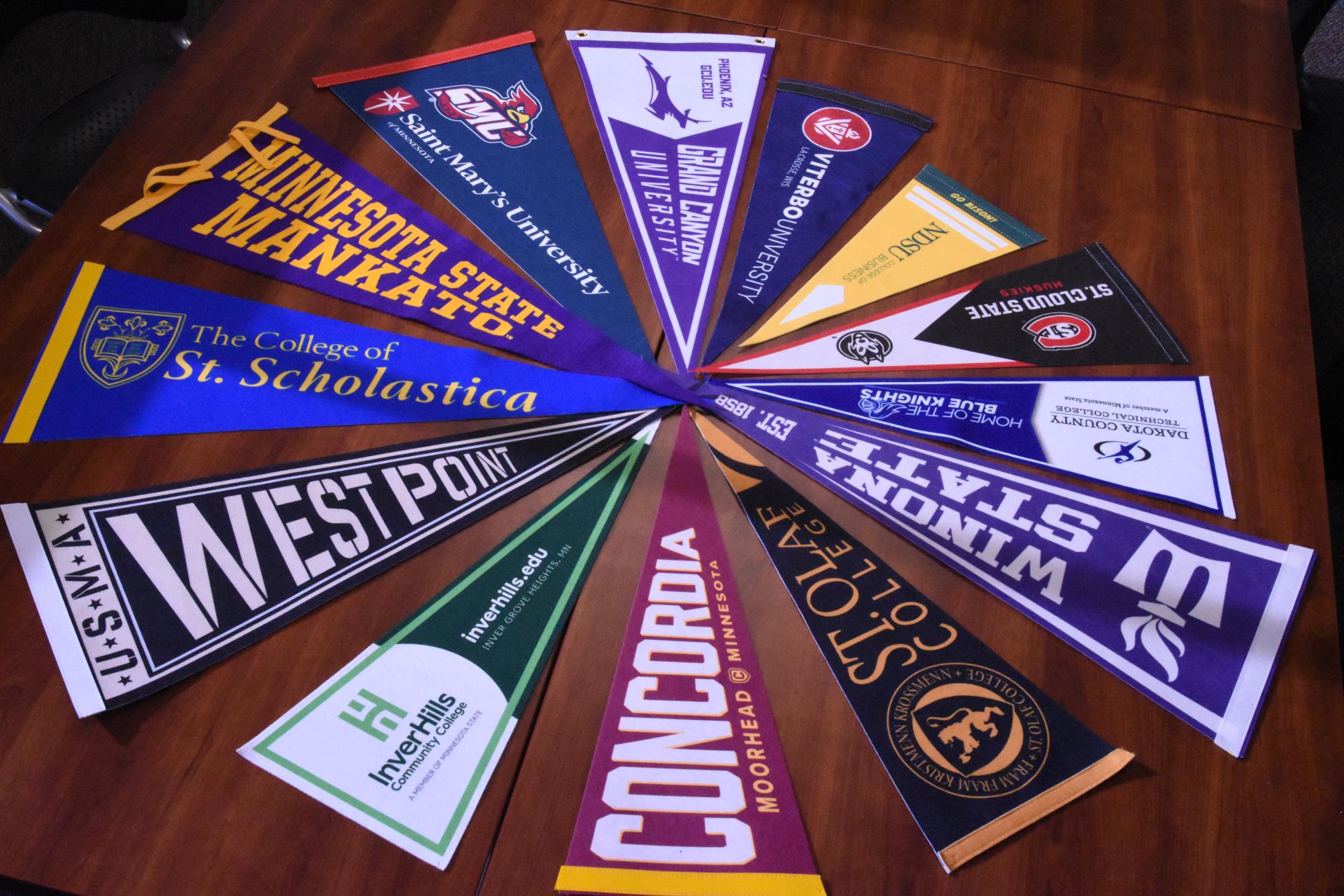
From Cannon Falls, students have chosen a large variety of different schools. More students choose to stay in state for their post-secondary education, with 4-year public schools being the most common choice. The top five schools for Minnesota public 2 and 4-year colleges have been Dakota County Technical College (DCTC), with almost 70 Cannon Falls students since 2015, University of Minnesota, Minneapolis being the second most popular choice, then Minnesota State University, Mankato, Inver Hills Community College, and Winona State University.
Cannon Falls has not had as high of a percent going to private colleges, with an average of 9 students per year, whether that is a 2 or 4-year option. The most popular choices were St. Thomas and Luther, both with 10 students. Next is Gustavus Adolphus College with 9, and St. Scholastica and Bethel with 8 each.
Outside of Minnesota, students have gone as far as Texas or even Washington, D.C. Some of the most interesting choices are the schools in D.C., which stand out both for their distance and prestige. Georgetown University is the highest-ranked of the three, typically appearing in the top 25–30 national universities. George Washington University follows, generally ranked in the top 60–70. George Mason University is recognized as a top 50–60 public institution and is also highly ranked for value and social mobility.
Some Wisconsin schools have a lot of students attending, likely because they are close to Minnesota. At the same time, there are many schools on this list with only one student attending, showing that Cannon Falls students explore a wide range of post-secondary options.
Overall, Cannon Falls graduates take a wide variety of paths after high school. Most stay in Minnesota, with public 4-year schools being the most common choice, but many also choose private colleges or out-of-state options. Some students travel far for prestigious or specialized programs, showing that Cannon Falls students are looking for opportunities that fit their goals, interests, and ambitions. Over the past ten years, the variety of colleges and universities chosen demonstrates that there is no single “typical” path—students are finding the schools that are the best fit for them.


Like how the common saying goes, money doesn’t actually grow on trees. It’s earned through dedication and hard work–oftentimes through jobs. For most high school students, that means putting aside spare time to make money for their own needs and to save for a higher, much more important, purpose: college. But not everyone has time or a job. Nor are most of them able to actually pay off the funds that college brings. To support those aiming for a higher education, different methods are optimized for students–loans, grants, and scholarships are the leading choices. Many local families and global organizations give out money through a special form of payment, known as scholarships.
Scholarships are free money granted by organizations or individuals to students going into college. Unlike loans, this money doesn’t have to be paid back. It’s a gift. Scholarships are not awarded to everyone, however.
High school students fill out applications–questionnaires used to recognize the student’s value or their personality–and oftentimes give a letter of recommendation or a themed essay to the selection committee. From there, the selection committee decides on the application they like most. Committees that give out multiple scholarships typically ensure that a student does not receive more than one scholarship from said committee. Students who are rewarded with money do not just take the money and run–it’s socially viewed as rude. Instead, recipients give donors thank-you cards to express gratitude for their generosity. With the wide variety of roads students go into after high school, there’s a plethora of scholarships out there to support the broad area.
Each scholarship comes with certain qualifications. Whether it requires applicants to be in a certain field or be an honor student, not everyone qualifies for it. Oftentimes, these are based on the history of the scholarship; either it’s to honor someone who passed away, or the organization was founded on those beliefs. Steve Clark, Cannon Falls High School(CFHS)’s Finance teacher, suggests a strategy seniors should use when picking scholarships. “Pick those that go with your specific skills, whether it’s art, science, etc. It’s a great way to go,” he says. Scholarships are not open year-round–they have what’s known as an “application window.” With spring blossoming soon, the seedlings of scholarship applications have started to open for seniors in CFHS.
Kirsten Hoffman, the guidance counselor for CFHS, helps communicate between seniors and local scholarship committees. She sends out a list of the scholarships and holds a presentation during school, so seniors are up to date and know what to do. Cami Anderson, a senior attending CFHS, has found the information extremely helpful. “I think the school does a great job making sure everyone has access to all the information they would need regarding applying for scholarships,” she states. Although the community gives tremendous support, it’s not the only method for students to get money for college.
Grants are also an option for seniors to pay off college, and are actually fairly similar to scholarships. Both give out free money, require applicants to apply, and are chosen through a committee. However, grants are based on financial need, not merit; they are determined by financial support, not one’s success in school.
Contrary to grants and scholarships, loans are a completely different method to get money–it’s not free. Loans are money that is borrowed and later paid back, with interest. Interest is an amount of money, oftentimes a percentage of the money owed, that is added onto the borrowed money. The surcharge is based on how long it takes for the money to be paid back. Typically, loans are lent from banks. It’s not the most ideal solution for college students, as the fees can be tough to pay back, but for many, it’s their only option. Combining scholarships and grants helps lower the loans taken out, making it much easier to repay.
A lot of seniors are preparing for their next step in life after high school. For some, that means taking on jobs or finding ways to make money for college. Time is money for seniors; colleges are expensive, so taking on a job isn’t going to pay off everything, and not everyone has time. Scholarships, grants, and loans are primary methods people use to support financially pay off their future education. It’s fundamental for seniors to understand the difference between these methods to avoid making mistakes that could cost them their education–or their future.