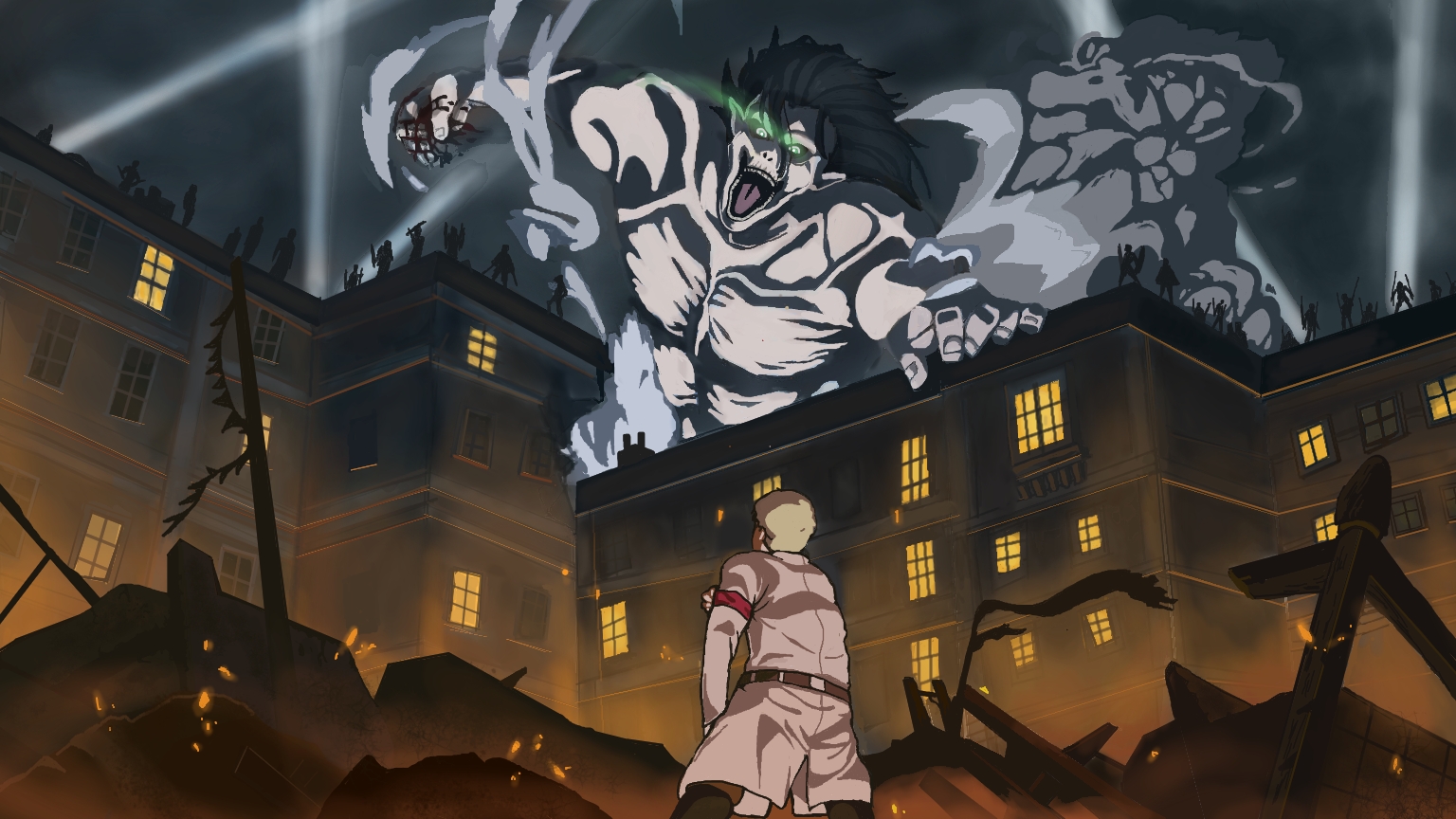

If there is a single thread from which every catastrophe in Attack on Titan is woven, it is not hatred, ambition, ideology, violence, tragedy, or war, but love, specifically, love in its most uncompromising, unregulated, and, ultimately, destructive form. Eren Yeager becomes a mass murderer, in part, because of his love for his friends, for Mikasa, and for the people within the walls. His love becomes something indistinguishable from fanaticism. Ymir Fritz, the progenitor of all Titans, subjected herself and her descendants to millennia of servitude out of love so total and unreciprocated that it became its own prison.
The series’ finale argues that love is what makes freedom possible and what makes it terrible. It is the only force capable of ending cycles of violence and the only force capable of beginning them. Though, love is not the only theme.
The three concentric walls, Maria, Rose, and Sina, map very closely onto the criminological model proposed by Ernest Burgess in the 1920s, the “concentric zone theory” of urban social stratification. In Burgess’s model, the innermost zones house the powerful and the affluent, while the outermost rings absorb the poor, the criminal, and the marginal. The walls replicate this with architectural literalness, for those who live nearest Wall Sina, nearest the king, enjoy the greatest safety and resources; those pressed against Wall Maria are most economically precarious and politically disposable, evident by the military’s callous culling of Shiganshina’s refugees in the 846 “reclamation.” What Isayama adds to this is the revelation that the walls themselves afre made of Titans, that the structure of oppression is not merely built upon the bodies of the subjugated but literally constructed from them. The Eldian people inside the walls are physically constituted by the same power that is used to dominate and destroy Eldians outside them. This is a materialist argument: the tools of liberation and the tools of oppression are identical. The wall that protects is also the wall that imprisons, and both are made of human flesh.
As for the outside of the walls, the nation of Marley governs through a racialized ideology in which Eldians are held collectively responsible for the historical crimes of the Eldian Empire. They are forced to wear armbands; confined to internment zones, one cruelly named “Liberio,” drawn from the Latin “I set free”; conscripted into military service as expendable weapons, primarily suicide bombers; and subjected to systematic dehumanization enforced by law and culture alike. Their propaganda and rhetoric apparatus produce a familiar narrative: that Eldians are “the spawn of the devil,” biologically distinct and morally inferior; their blood is the source of all historical suffering; the flattening of a diverse, internally varied population into a single, threatening archetype; the use of historical grievance as justification for present persecution; and the delegation of enforcement to instructions that gradually normalize atrocity through bureaucratic procedure. In case it wasn’t obvious, this explicitly parallels Nazi Germany and mid-twentieth-century fascism.
This is where Attack on Titan surpasses a simple allegory, however. The Warrior candidate: the Eldian child recruited into Marley’s military, raised to believe in the ideology of their own people’s inferiority, and deployed as a weapon against other Eldians. This has a precise historical analog in the Sonderkommando, Jewish prisoners forced by the Schutzstaffel to assist in the operation of the death camps and made complicit in the machinery of their own people’s destruction under threat of death. But the weaponization of children against their own kin also carries a distinctly literary echo, one George Orwell articulated in his novel, 1984. The Party’s Junior Spies program trains children from their earliest years to monitor the private speech and behavior of their own parents, to report ideological deviance to the Thought Police, and to regard the act of betrayal as the highest form of civic loyalty. A state that cannot trust adults to abandon their prior loyalties can instead cultivate a generation that never formed them. By colonizing the parent-child bond, the Party ensures that no household remains a refuge from its authority. Marley pursues the same rupture through a different method. Zeke Yeager, raised under enormous pressure by his father Grisha (also Eren’s father) to carry on the Eldian Restorationist cause (a small rebellion formed against Eldian oppression), reported both his parents to Marleyan authorities. Grisha was seized and sent to Paradis, forced to become a Titan. Likewise, his mother, Dina, was transformed into a Pure Titan (the hollow, smiling monster that would later devour Eren’s mother, Carla) and sent to Paradis. Zeke did this intentionally, and, at least initially, he never acknowledged it as a crime but rather as clarity, the act of a child who understood the world more honestly than his parents did, who was more loyal to the state, and who chose survival and ideological allegiance over a loyalty he had decided was a trap. This is the Junior Spy of Attack on Titan. Orwell’s Parsons is arrested on his daughter’s testimony and accepts it with something approaching pride; Zeke preempts his own parents’ fate and feels wise. The parent-child bond, in either case, has been reengineered into an instrument of the state so thoroughly that the child no longer experiences the betrayal as betrayal at all; it is a responsibility, and, in following through with it, effectively replaces the parents with the state and has no margin for opposing ideology.
Another victim of this indoctrination is Reiner Braun. His dissociative episodes, in which he genuinely cannot locate himself in his own identity, sometimes believing himself to be a Marleyan soldier, the Armored Titan, one of the Warriors, or a savior of the world; sometimes an Eldian boy, a cadet, fighting for the last of humanity, a savior—these episodes are not a result of mere dramaturgy but rather an accurate depiction of what sustained ideological contradiction and survivor’s guilt produce in the human mind, the most uncomfortable aspect of the Nazi analogy: not a leader of a vanguard of safety, peace, beauty, or perfection, but a victim of manipulation, an asset finely tuned by a system that could not care less about his individuality or agency. And like Orwell’s Parsons, Reiner cannot fully condemn the apparatus that destroyed him because that apparatus is the only identity he has even been given.
Broadly, the Nazi analogy is not as easy to make as it may seem, however. The Nazis’ propaganda depicted their victims as subhuman from a foundation of pure racial fantasy, whereas Marleyan propaganda is built on historical grievance with a genuine basis: the Eldian Empire did indeed commit atrocities, and the Titan power gave them an unfathomably large advantage. This complicates the oppressor-victim binary. Marley’s authoritarianism is the institutionalization of historical trauma, weaponized by a ruling class to maintain power. In this sense, Marley more closely resembles not only Nazi Germany but also the post-World War I birthing ground of that movement, a people wounded and fertile with grievance whose scars are tended by nationalist midwives who coax those wounds and prejudices into a new offspring: a hatred aimed at a scapegoat rather than toward the real, more difficult reasons responsible for their suffering.
This is, ultimately, what all authoritarian systems do with love. They take the love people have for their communities, their families, their cultural survival, and their state, and they redirect it outward into prejudice, hate, and blasphemy; inward into compliance, fear, and acceptance; and downward onto those with less power to resist. Following the Marley logic, how would one not merely oppress Eldians but solve the “Eldian problem”—permanently? Inevitably, the answer comes down to eugenics or genocide.
A primary, though often overlooked, dilemma lies within Zeke Yeager and the vision of Eldian liberation he proposes. Zeke’s plan is to use the Founding Titan’s power to sterilize all Eldians, ending their bloodline within a single generation. This is posited as a coherent response to the problem: if Eldians will always be persecuted, if the cycle of violence is genuinely inescapable, then perhaps the most merciful act is to end the line without further suffering. This is, in a sense, eugenics, and the premises sound awfully similar to the forced sterilization programs throughout the twentieth century. Nazi Germany’s Gesetz zur Verhütung erbkranken Nachwuchses (the Law for the Prevention of Hereditarily Diseased Offspring, enacted in 1933) mandated the compulsory sterilization of those deemed genetically unfit, a label they expanded to include disabled individuals, severe alcoholics, Roma, and Jews. But the United States had already provided the legislative argument: American eugenics programs, enthusiastically promoted by people like Madison Grant and institutionalized through laws in over thirty states, were studied and explicitly admired by Nazi legislators. Sterilization as state policy was not purely a German invention; it was a Western one, and, of course, it masqueraded as a solution to the “problem,” a demonstration of public health, and a step forward in social progress. Again, similar premises to Zeke’s plan. The horror derives from the fact that his argument is valid. Thankfully, it is not sound, though it remains valid, for if one were to accept his premises about the permanence of persecution and the impossibility of coexistence, his conclusion indeed follows. This is what makes eugenics so persistently dangerous as an ideology: it presents itself as a solution and, unless scrutinized, can seem acceptable to individuals charmed by a state’s propaganda. However, its error lies within the misidentification of what suffering’s source actually is.
Eren’s counterposition does not correct this error either; it is only the extreme inverse: instead of ending the Eldian population through forced sterilization, Eren chooses genocide directed toward any individual who is not an Eldian. The two brothers represent adjacent ideologies: both have concluded that the only answer to Eldian suffering is the elimination of the threat at its root, and both have been willing to make masses of humanity the cost of this conclusion.
Briefly addressed in the synopsis article is the radicalization of Eren Yeager, a process that follows a very recognizable pattern: a pre-existing vulnerability (the trauma of his mother’s death, the discovery of his father’s origin, and the weight of an inherited and immutable future), exposure to an ideology that gives his suffering meaning, social isolation from moderating influences, and the adoption of an identity in which violence becomes permissible and, in a sense, obligatory. This is similar to Achilles, whose own radicalization into consumptive rage is the renowned theme throughout the Iliad; both figures occupy a threshold between the human and the divine, Achilles through his immortal mother and his superhuman capacity for might, and Eren through his inheritance of the Attack and Founding Titans, powers so vast they shape will and history. Homer’s choice to open the Iliad with the word μῆνις—mēnis, or wrath—is itself significant, as the term was reserved almost exclusively for the anger of the gods, making its application to Achilles a theological statement about what he has become. Eren, too, is granted a kind of wrathful divinity by the narrative: his rage is aimed at the whole world he has already seen and already condemned. What makes Attack on Titan distinct in this portrayal, however, is that Eren’s fate is coerced: he has seen the future; he knows what he will do and what will happen. This is especially where Achilles and Eren differ ethically: Achilles was given a choice. His mother, Thetis, delivers the terms plainly: a long, forgotten life or a short one burned bright enough to outlast time, and whatever anguish accompanies it, the decision remains his to make. He chooses κλέος—kleos, glory—chooses the beach at Troy, and chooses the death he knows will come, and in that choosing retains something the narrative recognizes explicitly as agency, even dignity. Eren is afforded no such mercy. The Founding Titan’s memories present themselves as a hallway, not a crossroad, and what Eren inherits is not a future he chooses but one he witnesses, pressing itself backward through time into his bones before he has any capacity to refuse it. Where Achilles’ mēnis is ignited by grief and pride, emotions volatile but still recognizably human, still responsive to persuasion and to the weight of a dead loved one, Eren’s is something closer to a verdict handed down from outside the self entirely. And yet, Attack on Titan does not allow Eren to be read simply as a monster, insisting instead on framing him, from the perspective of Paradis, as something very close to what the Greeks would have recognized as a ἥρως—hḗrōs, hero—not in the diluted contemporary sense, of course, but in the ancient one, where the word carried the weight of sacrifice, of a life surrendered so that a people might survive, of kleos purchased at the cost of everything personal and recoverable. In this regard, Reiner Braun is the hero of Marley in exactly the same way, a soldier who destroyed himself in service of a story his nation needed, and Attack on Titan places these two figures in genuine parallel, forcing the audience to confront the fact that the Greek heroic tradition does not arbitrate between sides. Achilles is a hero; so is Hector. They are heroes together, symmetrically, and the city still burns. The tragedy the series implicitly insists upon is that the language of radicalization, of choice and ideology and the seduction of violence, may not fully apply to a figure who did not so much become what he is as discover that he already was, but that the language of heroism, with all its terrible glamour, applies to him completely and to his enemies in equal measure.
Attack on Titan is structured philosophically around two competing ideas for thinking about history.
The Hegelian view is implicit in historicism: thesis (Eldian imperial dominance), antithesis (Marleyan subjugation and resistance), and synthesis (the peace attempted after Eren’s defeat). History, in this reading, moves forward through conflict toward a resolution that incorporates and transcends what came before. Eren’s genocide, mourned by Armin and Mikasa, produces a new political moment in which old enmities are at least partially dissolved. But the series’ final pages resist this Hegelian optimism by invoking Nietzsche’s eternal recurrence: the idea that all things, including history, cycle infinitely and that the same configurations of power and suffering return again and again without terminus. The last scene (Shiganshina is carpet-bombed by modern aircrafts) suggests that the peace achieved through Eren’s death is necessarily temporary. The dialectic has not resolved into synthesis; it has only completed one rotation of a wheel. Humanity will forget, will fear again, and will build new walls and find new enemies to place outside them. No single act, however enormous, permanently solves the problem of human violence. The answer is the ongoing, ordinary, unglamourous practice of choosing differently each time the wheel comes around.
And thus the series returns to where it began. Mikasa kills Eren because she loves Eren. Her love is mature enough to refuse his preferred ending, in which she would flee and forget, and honest enough to choose his death over his continuation. It is, by any measure, the most costly act of love in the series, and it is what finally frees Ymir Fritz from her millennia of servitude. Ymir, who could not free herself from her love for the king who enslaved her, is released by seeing that love can end cycles rather than perpetuate them.
This is Attack on Titan’s final answer to its own politics, its eugenics debates, its war dilemma, and its endless recurrences: not a system, ideology, or Titan of righteous destruction, but a woman making the hardest possible choice for the person she loves most. It is an answer almost embarrassingly intimate given the scale of everything that precedes it. But that intimacy is precisely the point.