
“Boys are just better at math and science!” is a fixed mindset. It’s like saying, “This is how it is, how it has been, and there is nothing we can do about it.” The vast majority of people who believe this are uneducated about what they are talking about. In reality, there is just a harsh line on how girls have grown up versus how boys have grown up. That line can create gender gaps. These can occur in education.
A gender gap in education is when one gender is doing noticeably better in a school subject than the other. Currently, middle school girls are falling behind in science and math, possibly because of COVID-19. While other age levels show girls ahead of boys, according to AP News. This may cause people to wonder whether one gender thinks differently from the other. That’s not the case. It’s about how they are taught to think, according to Chelda Smith, Associate Professor of Education at the University of St. Thomas, as interviewed by Lillian Olund and Isla Harrison.
A conversation over this topic can get messy quickly, especially when talking to middle school students. When an eighth-grade girl finds out about this, she doesn’t hide her emotions. “What! I feel like girls would be better than boys at math and science,” compared to an eighth-grade boy who takes pride in this. “I feel cool!” he says. When the eighth graders began to go back and forth trying to prove their point that their gender was superior, it became apparent very quickly that the students may not see that as an active problem. It is more like a game of tug of war – someone has to win, and someone has to lose. But in the end, it’s just a game for them.
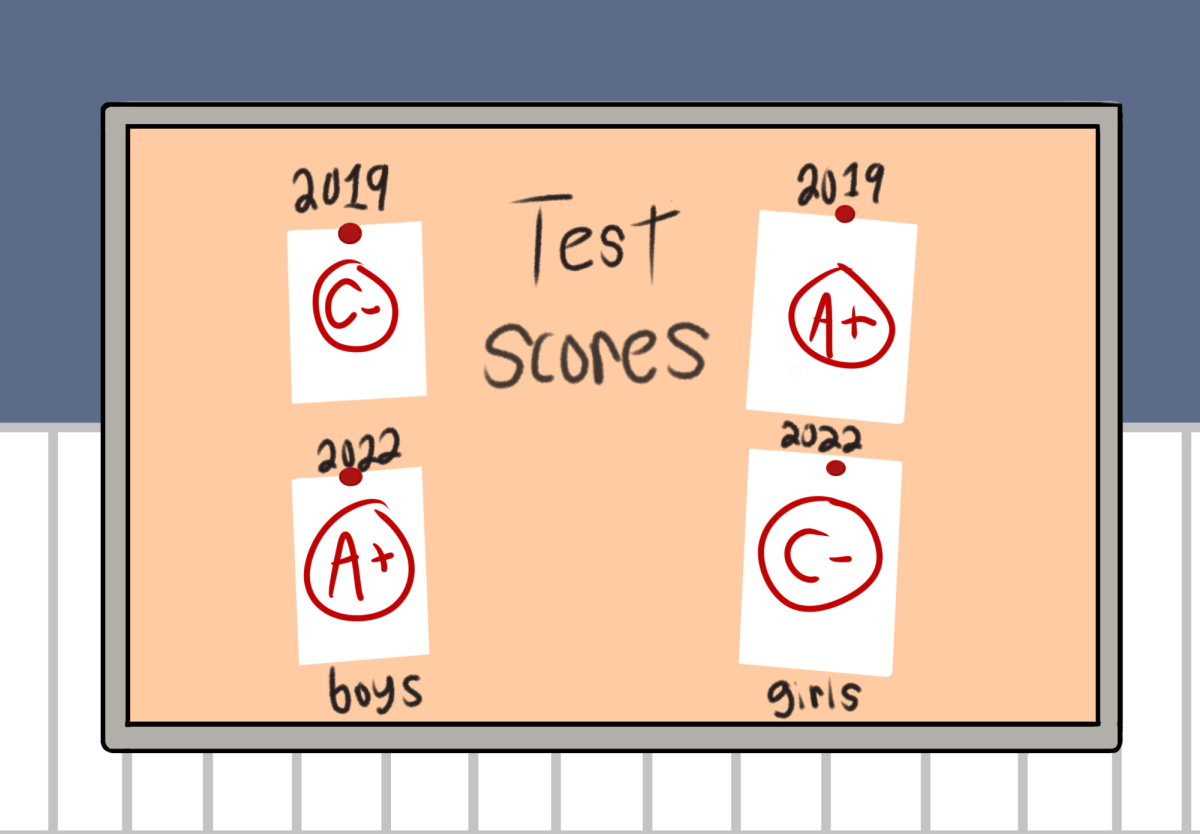
Girls are falling nearly a half a grade behind. Recent and past standardized test scores in math are showing that between 2019 and 2022, boys have steadily gone up, while girls have plummeted in the third through eighth grade. A study of around 5,000 school districts shows that in 2024, boys outscored girls with a better average for their test scores in 3,789 more school districts than girls outscored boys. The gender gap is even bigger than it was in 2009, according to MinnPost. All of that progress went away. There are possibilities on why this may be happening, but one theory in particular is spreading like wildfire among many people, but it’s clearly not enough to make a change in the school districts and classrooms. The theory is that after COVID, the learning style changed, benefiting boys academically. The same did not go for girls; it ended up harming their education.
Around the 2010s, multiple districts, teachers, parents, and others realized that something was off. In fact, the study mentioned above showed that boys outscored girls in 729 more school districts out of 5,000 than girls outscored boys in 2009. They realized that there was a noticeable gender gap with girls behind in STEM (Science, technology, engineering, and math). So they decided to make some changes in the teaching style. The staff, parents, board members, and more came to a conclusion that they were going to try to get the girls more engaged in STEM. Along with that, they decided to add more hands-on learning to their curriculum. As a result, girls surpassed boys in test scores by 2019, according to the MinnPost. This is a similar concept to how, in Cannon Falls Middle/ High School, the district and board members decided that the reading test scores for middle school state testing weren’t where they wanted them to be. There has been a difference made as a result of the board and district deciding that they were going to add an extra twenty-minute class period every Wednesday for the sole purpose of reading.
After the pandemic, there was an upheaval. Though girls were finally ahead and were officially doing better, in an instant, it came to an abrupt end when COVID hit. Girls’ test scores dropped significantly in science and math. An idea of why girls were falling behind and not boys is the fact that most girls had more responsibilities and stress. But that theory is not completely factual. This is because girls are still ahead in reading as they were before the pandemic, according to AP News. So if the problem isn’t attributed to stress, what is the cause of this increasingly large gender gap?
A theory that really pieces together this puzzle is that after Covid-19 district, girls are engaging less in STEM, which is leading to them having a harder time, according to AP News. The amount of hands-on learning significantly decreased, leading to girls’ test scores dropping. This wasn’t on purpose. It was just that the American educational systems had to get back in the groove quickly, even if that meant going back to more original teaching methods, according to Chelda Smith, Associate Professor of Education at the University of St. Thomas, as interviewed by Lillian Olund and Isla Harrison. And since districts have gotten back to the typical learning style, which favors competitiveness, it has given boys an impactful lead because of their strongly driven learning style.
It might come across as strange that boys and girls have different learning styles. Chelda Smith, Professor of Education at the University of St. Thomas, said that “We’re born very much the same, mentally…Girls are socialized or nurtured to lean more towards care-based interactions.” It’s not just the learning styles that are different. It also has to do with how they act. No one is born different. Boys and girls are just taught and molded to be different. They’re different even in social situations. Smith goes on to state, “The remembering of sentimental things; girls are not wired to do that, they’re taught to do that. And often when a girl doesn’t do that, then we judge that girl as not being girl enough.”
With girls not being given the same opportunities as boys, it partially leads to them falling behind. Before COVID, many people identified this predicament and were making an effort to even out the playing field. Boys never started to fall behind; girls just got the same opportunities and started to excel. That extra effort to give the girls equal footing compared to the boys, for the most part, disappeared during and after COVID-19. It was shown by a lack of concern for equal opportunities after Covid 19, according to Chelda Smith, Associate Professor of Education at the University of St. Thomas, as interviewed by Lillian Olund and Isla Harrison. “If a pandemic can come and all of a sudden we don’t pay attention anymore, that means it wasn’t institutionalized. That means it wasn’t written in the budget permanently. It wasn’t written in the policies of the school. It wasn’t designed exclusively to stay forever and be sustainable. Instead, it was just like a, we’re just gonna keep seeing how it goes, and we learned that lesson,” states Professor Chelda Smith.
Younger kids were also strongly impacted because of COVID, according to the New York Times Article – Why Boys Are Behind in School From the Start. When toddlers start their lives isolated and around screens, that can negatively impact them. And boys are typically unprotected from these hardships. Also, Kindergarten is one of the grades where students learn the basics for all their future skills. And if students start to feel like they are not measuring up at a young age, they could stop applying themselves in the future.
Gender gaps in education have been around for a long time. They show the differences in how people learn, the priorities of their time, and how people think. Some gender gaps have gotten steadily smaller over the years, giving some boys and girls equal opportunities. “That change has never come, or hasn’t succeeded without intervention, purposeful or not. Someone needs to step in and make the changes necessary to make things as equal as possible. Whether that is acknowledging gender gaps in middle school, all the way up to college levels,” according to Chelda Smith, Associate Professor of Education at the University of St. Thomas, as interviewed by Lillian Olund and Isla Harrison. There needs to be recognition to make a difference.

An idea that may lead to the root of the problem is the changes made in the last couple of decades in early schooling. This change has made kindergarten less about activities, playing, or working with others, and more about academics like math and reading. So if kids get in school right after dealing with COVID, and then have to deal with learning how to sit still and be quiet, it can be hard. Since boys mature later, so can their abilities to stay on task and listen, according to the New York Times – Should Boys Start Kindergarten a Year Later Than Girls. These reasons, combined with the shorter attention span these new generations have because of screens, can lead to boys falling behind quicker than girls.
When a female and male sixth-grade student were asked if they thought that this was a good idea, the female didn’t hesitate to share her opinion and said, “Yeah, they should,” even before the question was fully stated. Once the question was over and a little bit more information about redshirting was shared, she stuck with her original answer and added “that can just show how much smarter we are than,” to her answer and reasoning behind it. To which the male student responded, “I think it just takes longer for boys to grow more, like educational-wise.”
The cons of redshirting are that not all families can afford to pay for another year of child care. In the long term, boys will become adults earlier than usual in schooling, which could give more kids the ability to drop out of school. It may turn out to be the opposite, though. Boys will be more mature earlier, which makes them less likely to make bad decisions as minors, according to The New York Times – Should Boys Start Kindergarten a Year Later Than Girls.
Though it may not be apparent just by looking at the test scores, high school has been affected by Covid too. The effects in high school are a little bit different, though. In a similar situation to high school, college has been affected by Covid too. Chelda Smith Kondo says, “From 2020, I’m still seeing my students now socially be so caged and uncomfortable interacting with each other as a result of Covid. So when you’re having to focus on how to make friends in college and how to talk to the person next to you in college, it’s a lot harder to be able to then say like and ‘let’s go ahead and go against society’ It’s harder to make that leap when we are still at ‘Can you have a conversation?’ “ It’s hard to focus on the way students learn when the students are having trouble just talking with each other. We are still seeing the impacts of COVID years later in both education and socially.
When looking closer, it is evident that regardless of age or gender, all were affected by COVID, especially middle and elementary school students’ education. There are some similarities that can be seen among all these people, but there are some differences too. The true problems lie in culture. To get test scores and education levels back up for girls, it is going to take some sort of intervention, according to Chelda Smith, Associate Professor of Education at the University of St. Thomas. All it takes to make a difference is a little act of help and a little bit of convincing, and then there is a whole party of people who are ready to help. It’s just like a fashion trend. Once one person does it, it can set off a chain reaction. There can be a whole world of difference made just from one person’s act of help. So it is important to make an effort to be that person who makes a difference.