
Death Note (2006) is the anime adaptation of Tsugumi Ohba’s true crime manga. It’s a thrilling show in which themes of justice, power, and moral absolutism are tested and examined but never labeled; it makes direct parallels to ancient literature and philosophical texts, a few of which will be referenced in this article. With the main protagonist, Light Yagami, the series critiques forms of absolutist government, cross-examines the seductive allure of injustice, the weakness of seemingly strong moral boundaries, the validity of vigilantism, and the meek societal complicity in moral corruption. The events discussed will remain largely spoiler-free and assume the TV show’s canon.
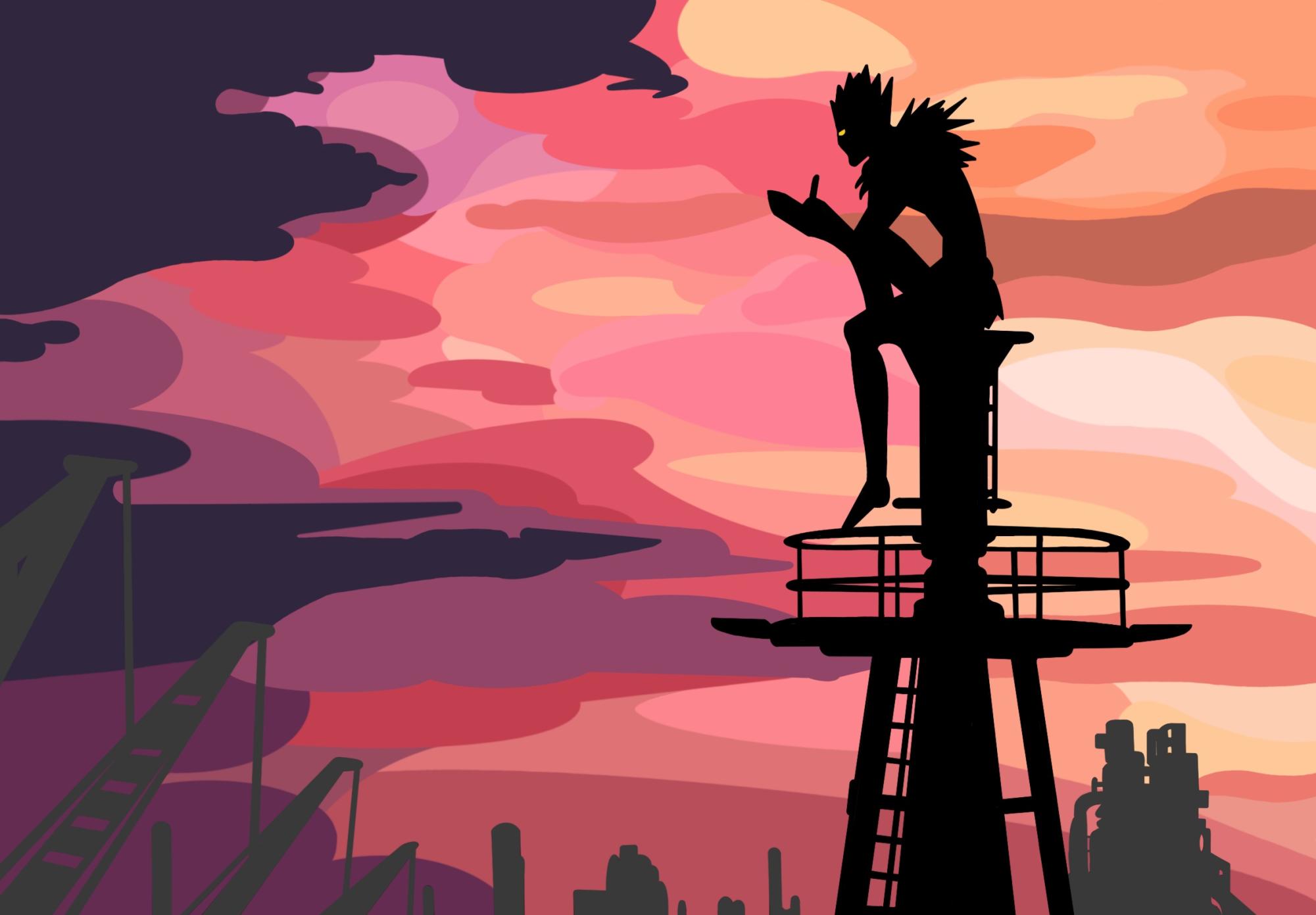
For simplicity, the premise is this: Light Yagami is an intellectually bright high-school student who stumbles upon a divine notebook that allows him to kill anyone whose name is written in it, granted he knows their face. The Death Note, dropped by the God of Death (or Shinigami) Ryuk out of boredom, becomes Light’s instrument of “purification.” He adopts the alias “Kira” and begins executing criminals en masse. Light believes himself to be nothing less than a god and the architect of a utopia free of crime and evil; however, as the body count rises, so too does the ambiguity of his self-proclaimed righteousness and anonymity, with world-renowned detective “L” becoming the show’s central antagonist as Light’s direct opposition—attempting to solve the “Kira case” and identify the perpetrator.
Seemingly, Light’s descent into vice is typical and follows familiar archetypes. Initially motivated by a virtuous desire to rid the world of evil, he quickly becomes intoxicated by the power to decide who lives, who dies, and in what way. Put simply by Lord Acton, “Absolute power demoralizes,” but in Light’s case, the Death Note both reveals and accelerates morals that were already compromised. Moreover, Light’s fall is not marked by a single moment or action per se, but by a gradual decay of his ethics. He begins with criminals but soon begins targeting those who merely oppose him ideologically: investigators, police, government agents, and even innocents. Anyone who threatens his anonymity.
This theme alone seems very resonant of Glaucon’s Ring of Gyges allegory found in Plato’s work The Republic. The story follows a shepherd, who, after finding a magic ring, realizes that it can turn him invisible; after discovering this, he murders the king and takes control of the kingdom, with Glaucon essentially arguing that justice is entirely performative and that, regardless of being a just or unjust man, all would fall victim to the sheer power given to the bearer of the ring. Further interrogating justice alongside Light reveals more: for example, would the just consider Kira a hero or a villain? Regardless of Light’s professed motives, the Death Note represents Glaucon’s ring, removing the constraints that make moral behavior meaningful. Overall, it represents just how quickly principle can be traded for efficacy.
Moreover, Light believes he is enacting a higher form of justice, one unencumbered by bureaucracy or legal loopholes; yet his justice is predicated on fear, not fairness. As Michel Foucault argues in his 1975 work titled Discipline and Punish, power that surveils and punishes without accountability becomes a mechanism of control rather than correction; for example, 1984 (George Orwell), Brave New World (Aldous Huxley), or The Trial (Franz Kafka). Light’s “justice” is retributive and cathartic, not restorative or ethical. Crime rates drop purely because of the societal fear he has engineered.
While Light’s reach does not yet equal that of fully realized totalitarian states, like in the aforementioned novels, his ideology mirrors their foundational logic; crucially, authoritarianism does not require an extensive, organized bureaucracy to exist—personalist or theocratic despotisms can rise from a concentrated, unaccountable authority exercised by a single actor or small network. Having established that, Light’s rapid transformation from an intellectually bored student into a self-proclaimed god demonstrates how quickly this personalist power can consolidate; thus, although he may not yet match The Party’s (the totalitarian regime found in the novel 1984) apparatus, if left unchecked, he could parallel or even surpass it.
However, this raises the question: what does Light’s desire for authoritarian control reveal about his character? His utopia is not democratic; it is a despotism, or even a theocracy, with himself as the absolute ruler—or god—demanding obedience rather than consensus or reform. Is this because Light himself felt powerless before receiving the Death Note? Very likely. The previous paragraph referred to Light’s justice as “retributive” and “cathartic”; these words fit his actions perfectly. As set up before Light obtains the Death Note, Light already holds profound contempt for contemporary society, which he regards as broken and rotten—a view reinforced consistently by his peers and the constant broadcast of crime and injustice in the media.
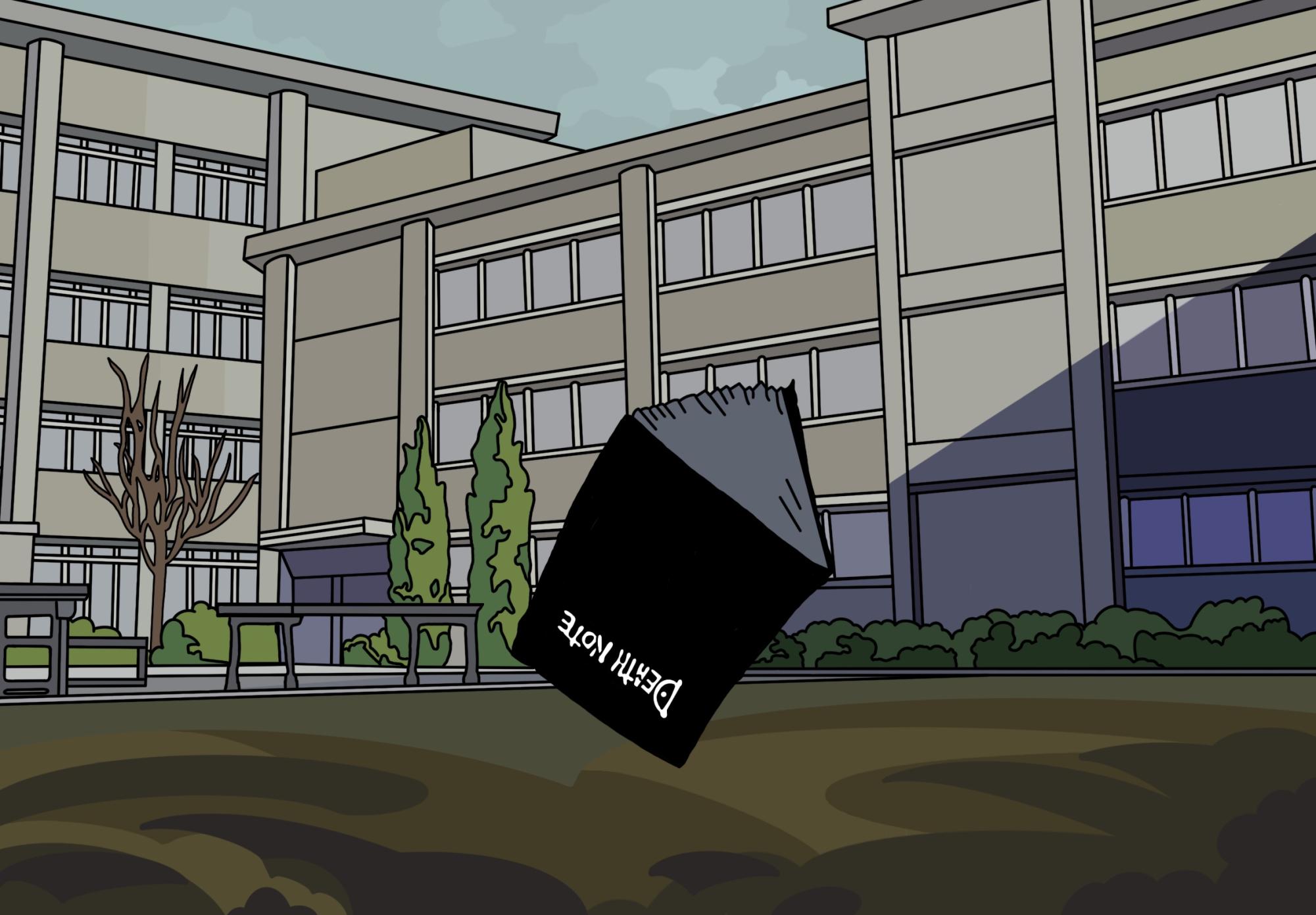
Immediately after finding the notebook, he speculates about its use and, within hours, declares with disdain and arrogance that he would “do society a favor by killing,” conceding just how quickly private contempt can be manipulated into public coercion. And rather than seeking reform or accountability, Light pursues unilateral, spiteful measures that erase pluralism, mercy, redemption, and the institutional safeguards that make justice possible, thereby producing a regime that treats the accused as guilty until proven innocent.
Humanity’s general perception of Kira as divine is one of the show’s most underrated topics, for as fear spreads, so does reverence. Countries, such as the United States, bow down; online forums and fan websites are full of praise—even specific kill requests—and a cult-like mass worships the unseen, seemingly divine, executioner. This phenomenon
directly mirrors real-world totalitarian regimes, where fear and admiration often coexist; totalitarian leaders often thrive not only on coercion but also on the willing submission of the masses, who find comfort in the illusions of order, whether by force and coercion or not. Kira’s followers do not merely tolerate his killings; they exalt them and rejoice over the erasure of fellow people. What does this say about the security of the masses?
Light, himself, is well aware of this duality, and, in a moment of arrogance, he muses that while people publicly denounce Kira, they secretly support him. This observation points out the paradox of online anonymity. The familiar difference between public virtue and private vice. Just as real-life users on the internet may express socially unacceptable views behind the mask of anonymity, citizens in Death Note’s world privately endorse Kira’s executions while outwardly condemning them; thus, the show critiques not only Light’s authoritarianism but also the societal hypocrisy that enables such actions.
The theme of vigilantism is also very prevalent throughout the show. Light is bypassing the legal system. None of what he is doing is legal by any means, and yet he is supposedly fixing the world? While vigilantism is still debated in modern society, Death Note remarks through Light’s opposition that he is no less than a mass murderer who happened to come across the deadliest weapon known to man. Juxtaposing Light with L, the previously mentioned detective, the show portrays the modern debate of vigilantism through the two. L opposes Light—Kira, and in doing so, he represents modern procedural justice—imperfect, methodical, and bound entirely by rules; their constant cat-and-mouse game not merely a battle of wits but a metaphorical duel between the two opinions of vigilantism: one rooted in law and order, the other in will, self-proclaimed divinity, and fake virtue.
The show forces introspection in many ways. For example, the seemingly contrary nature of Light’s outlook on people being hurt: satisfaction when a criminal dies, but unease when an innocent person is merely threatened. Intentionally manipulating these themes, the show asks many questions: Is Light doing the right thing? Are the viewers complicit in Kira’s form of justice? Do the viewers, like the people portrayed in the show, crave order just so desperately that they are willing to overlook the cost? In this way, Death Note becomes a metaphorical mirror of sorts, reflecting the viewers’ own doubts toward punishment and the justice system. It never outright declares who is “good” and “bad,” but requires the viewer instead to contemplate the ethics of control, the allure of power, and the true nature of what they deem justice.
In conclusion, the plot warns the viewer that even the desire to do good, when untethered from respect, humility, and accountability, can become entirely performative—whether driven by pure ego or not. Representing the figure of a despot: corrupt and dishonorable. In the end, Death Note does not ask whether Kira was right or wrong—it asks whether the viewer, given the same power, would be any different from Light.